Standing Room Only: How the Venetian Bar Culture Is Quietly Changing the Way Dublin Drinks

There's a particular kind of magic that happens when you're handed a small glass of something cold and natural, you've got nowhere to sit, and nobody seems to mind. You lean against a marble counter, the room hums with conversation, and time does something peculiar — it slows down without stopping. This is the bacaro experience, born in the calli and campi of Venice, and it has, quietly and without much fanfare, started to take hold in Dublin.
It didn't happen overnight. But if you pay attention to the city's bar landscape right now — from the cobbled lanes of Temple Bar to the quieter corners of Rathmines and Stoneybatter — you'll notice a different kind of establishment emerging. Smaller. More intimate. Focused almost obsessively on what's in the glass rather than what's on the screen above the bar.
What Makes a Bacaro a Bacaro
In Venice, a bacaro is not simply a wine bar. It's a philosophy. These tiny, often centuries-old establishments serve ombre — small pours of wine, typically local — alongside cicchetti, the Venetian answer to tapas: small bites of cured meat, creamed salt cod on bread, tiny arancini, or whatever the kitchen has on hand that day. The point is never excess. It's precision. Pleasure in miniature.
Standing is part of it. Not because there's no room for chairs, but because standing keeps things moving, keeps conversation fluid. You drink, you eat a bite, you move on, you stay a little longer than you planned. That rhythm — unhurried but never static — is what Dublin's newer wine bars are attempting to translate into an Irish context.
And they're doing it remarkably well.
The Dublin Bars Getting It Right
Ask anyone who has spent time exploring Dublin's emerging natural wine scene and the same handful of names come up. Small spots where the wine list reads like a letter from a small Italian producer you've never heard of but immediately want to visit. Places where the person pouring your glass can tell you which hillside the grapes came from and why the vintage was difficult.
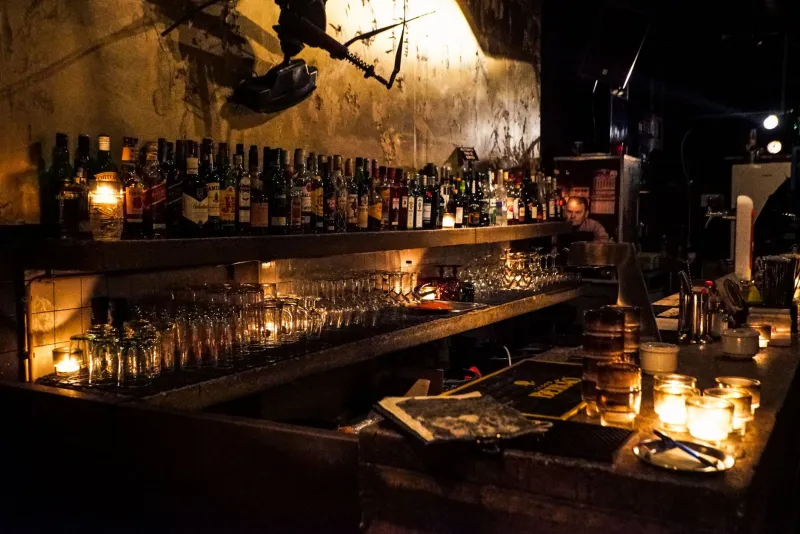
These bars tend to share certain characteristics: low lighting, no reservations, a short but thoughtful food offering, and a genuine curiosity about what's in the bottle. Natural and low-intervention wines — often from Italian regions like Friuli, the Veneto, or Campania — dominate the lists. Orange wines, pét-nats, and skin-contact whites that would have baffled Dublin drinkers a decade ago are now met with genuine enthusiasm.
Sommeliers working in these spaces talk about a shift in how their customers approach wine. Less brand recognition, more terroir curiosity. Less "I'll have a Pinot Grigio" and more "what's interesting right now?"
"People are asking better questions," one Dublin-based sommelier put it recently. "They want to know the story behind the wine. They're not just drinking — they're listening."
Why This Works in Dublin
It might seem counterintuitive. Dublin has a deeply embedded pub culture, one built around pints, warmth, and the kind of extended session that takes up an entire evening. Why would a city so comfortable with its own drinking rituals be drawn to something so distinctly foreign in its bones?
The answer, perhaps, is that the two cultures share more than they appear to. Both the Irish pub and the Venetian bacaro are built on community. On conversation. On the understanding that what you're drinking matters less than who you're drinking with and how long you linger. The format is different, but the instinct is the same.
There's also the matter of timing. Post-pandemic Dublin developed an appetite for smaller, more considered experiences. Fewer megabars, more neighbourhood spots. The bacaro model — low-key, personal, built on quality over volume — fits neatly into that cultural moment.
The Natural Wine Question
You can't talk about Dublin's bacaro movement without talking about natural wine, and you can't talk about natural wine without acknowledging that it remains, in some circles, divisive. Critics point to inconsistency, to wines that are cloudy or funky in ways that feel accidental rather than intentional. Enthusiasts counter that conventional wine has simply trained us to expect a kind of manufactured smoothness that erases character.
In the context of Italian wine specifically, the natural movement connects to something older than any trend. Many of Italy's most traditional winemakers — particularly in regions like Emilia-Romagna, Campania, and Sicily — have been making wine with minimal intervention for generations, not as a statement but simply because that's how it was done. What's new is the language we use to describe it and the international appetite for it.
Dublin's better wine bars understand this. They're not selling ideology with every pour. They're offering wine that has a point of view — and trusting their customers to find it interesting.
Bringing It Home: The Bacaro Experience for UK Readers
If you can't make it to Dublin (or Venice) immediately, the bacaro spirit is surprisingly portable. A few principles to take with you:
Keep the pours small. The ombra is typically 75–100ml. This isn't stinginess — it's an invitation to try more things, to compare, to pay attention.
Serve something to eat. It doesn't need to be elaborate. Good bread, a piece of aged cheese, some marinated olives, or a tin of quality anchovies. The food exists to support the wine, not compete with it.
Choose wines with personality. Seek out Italian producers from less familiar regions — a Vermentino from Sardinia, a Nero d'Avola from Sicily, a Ribolla Gialla from Friuli. Your local independent wine merchant will almost certainly have suggestions.
Stand up. Or at least resist the sofa. The bacaro experience is about presence and conversation, not settling in.
Don't rush, but don't stall. The beauty of the format is its natural rhythm. A glass, a bite, a conversation, another glass. Let the evening find its own pace.
What Il Baccarò Brings to This Conversation
Here in Dublin, we've built our own identity around exactly this kind of drinking culture. The name says it all — baccarò is our homage to that Venetian tradition, our commitment to wine that means something and food that earns its place on the counter. We're not replicating Venice. We're finding what Venice's spirit looks like when it breathes Irish air.
And if the broader movement across Dublin's bar scene is anything to go by, this city is ready for exactly that kind of drinking. Slower. More curious. A little more willing to stand still and pay attention to what's in the glass.
Sometimes the best thing a bar can do is give you something worth staying for.