Slow Down or Burn Out: What Italian Mealtimes Know That British Work Culture Has Forgotten
Britain is tired. Not the kind of tired that a good night's sleep fixes — the deep, structural exhaustion of a culture that has confused busyness with worth. You see it in the sad desk lunches, the 6pm emails sent with a quiet sense of pride, the way people answer "how are you?" with "mad busy" like it's a compliment. Somewhere along the way, the UK decided that rest was laziness in disguise, and we've been paying for it ever since.
Italian culture never got that memo. And sitting at a table at Il Baccarò Dublin, with a glass of something cool and honest in your hand, you start to understand why.
The Productivity Trap Nobody Wants to Name
The numbers are uncomfortable. The UK consistently ranks among the most burned-out workforces in Europe. A 2023 report from the Mental Health Foundation found that nearly three-quarters of British adults had felt overwhelmed or unable to cope at some point in the previous year. Stress-related sick days cost the economy billions annually. And yet the cultural response, more often than not, is to suggest people need better time-management apps rather than a fundamentally different relationship with time itself.
Italy doesn't have a perfect work-life balance either — ask anyone who's tried to navigate Italian bureaucracy — but it does have something the UK has largely abandoned: a shared cultural agreement that certain hours belong to pleasure, and that pleasure is not something you have to earn.
The long lunch. The passeggiata. The aperitivo hour. These aren't indulgences for the wealthy. They're structural features of daily life, built into the rhythm of the day like punctuation in a sentence. They exist because Italians understood, long before neuroscience confirmed it, that the human mind needs permission to stop.
What Happens to Your Body When You Actually Sit Down
There's a physiological argument here that's worth making plainly. When you eat quickly — at a desk, standing over a kitchen counter, scrolling through your phone — your body remains in a low-grade state of alertness. The sympathetic nervous system, the one responsible for your fight-or-flight response, doesn't fully disengage. Digestion suffers. Cortisol stays elevated. You finish eating and feel vaguely worse than when you started.
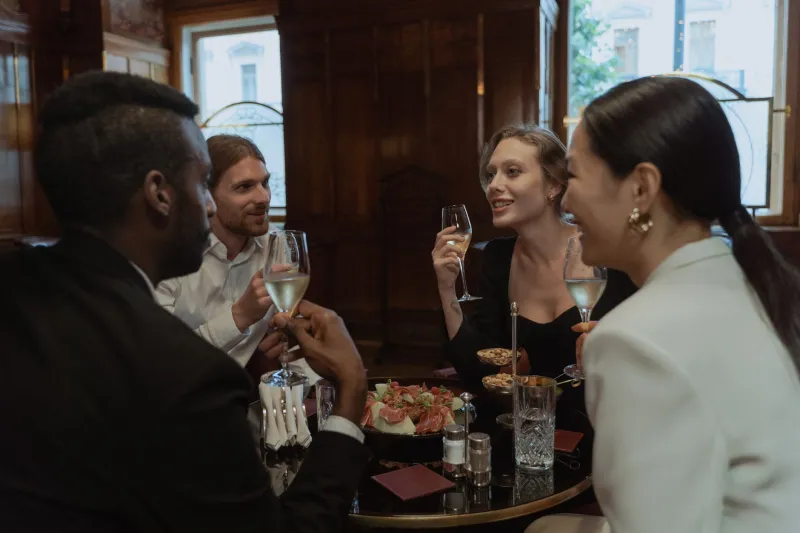
Contrast that with the Italian approach to a meal. You sit. You take a breath. There's bread on the table and no particular urgency about what comes next. Conversation starts slowly, the way a fire does. Your nervous system, sensing the absence of threat, begins to shift. The parasympathetic system — the rest-and-digest mode — takes over. Your body actually processes food the way it was designed to. You leave the table feeling replenished rather than refuelled.
This isn't mysticism. It's basic biology. And it's something that an Italian dining space, almost by architectural and cultural design, tends to facilitate without you having to consciously try.
Il Baccarò as a Kind of Recalibration
There's a reason people describe walking into Il Baccarò Dublin and feeling their shoulders drop. It's not just the wine, though the wine is excellent. It's the particular quality of a space that hasn't been designed for throughput. The Venetian bacaro tradition — the original inspiration behind Il Baccarò — was never about efficiency. It was about the opposite: giving people a reason to linger, to lean against a bar and let the conversation go where it wanted, to order one more small thing because the night was still young and nobody had anywhere better to be.
For a British professional who has spent the week in back-to-back meetings and eaten lunch at their desk three days running, stepping into that kind of environment isn't a luxury. It's closer to a corrective. The space itself does the work of reminding you that another pace is possible.
Regular visitors often describe it in similar terms — not as an escape from real life, but as a return to it. A chance to remember what it feels like to be a person rather than a productivity unit.
La Dolce Vita Isn't a Holiday Mood
The phrase la dolce vita gets flattened in British culture into something it was never meant to be: a holiday fantasy, a Pinterest aesthetic, a lifestyle brand. The sweet life, in its original Italian sense, isn't about Amalfi sunsets and linen trousers. It's about the daily practice of taking pleasure seriously. Of treating a meal, even a simple one, as something worth your full attention.
That's a genuinely subversive idea in a culture that has spent decades treating attention as a resource to be optimised. The Italian meal insists on the opposite: that some things deserve to be slow, that conversation is not a waste of time, that the hour you spend over pasta and wine is not time stolen from your real life but the very substance of it.
British professionals are beginning to catch up with this. There's a growing appetite — and it's showing up in how people choose to spend their evenings and weekends — for experiences that actively resist the pace of the working week. Not passive consumption, not another boxset, but genuine presence at a table with people they care about.
The Case for Eating as a Mental Health Practice
It might sound like a stretch to describe a long Italian dinner as a mental health intervention, but the evidence is increasingly hard to dismiss. Research into social eating — the act of sharing a meal with others in an unhurried setting — consistently finds associations with lower anxiety, better mood, and stronger feelings of social connection. The mechanisms are multiple: eye contact, shared laughter, the physical act of passing food, the absence of screens.
What Italian dining culture has always understood intuitively, psychology is now confirming empirically. The table is a therapeutic space. Not in a clinical sense, but in the original meaning of the word — something that serves the whole person, not just the hungry one.
When Il Baccarò fills up on a Thursday evening with people who've crossed the Irish Sea or simply crossed the city, what's happening isn't just dinner. It's a collective act of decompression. A room full of people giving themselves permission, perhaps for the first time all week, to simply be somewhere without needing to be productive about it.
One Table at a Time
You don't have to move to Italy to access this. You don't even have to overhaul your entire relationship with time in one go. You start with one evening. You put your phone face-down on the table — or better still, in your bag. You order something you've never tried before and ask about it. You let the meal take as long as it takes.
It sounds almost embarrassingly simple. That's rather the point. The antidote to burnout culture isn't a more sophisticated self-optimisation strategy. It's just a table, some good food, and the radical act of not rushing through it.