Point, Nod, and Trust the Counter: Ordering at an Italian Wine Bar When You Haven't a Clue
There's a particular kind of panic that settles over British travellers the moment they realise a menu isn't going to save them. You scan the chalkboard. You squint at the handwritten labels on the little plates lined up behind the glass. You look for something — anything — that resembles a word you recognise. And then, just as the person behind the counter looks at you expectantly, your brain empties completely.
Here's the thing, though: that moment of mild bewilderment? It's not a problem to be solved. It's actually the whole point.
The bacaro — Venice's original neighbourhood wine bar, the tradition that inspired everything we do at Il Baccarò — was never built around menus. It was built around counters, around instinct, around the quiet confidence of someone who's done this a hundred times pointing at something that looks good and saying yes. You don't need Italian. You need curiosity, a bit of nerve, and a willingness to let go of the idea that you should understand everything before you commit.
Forget the Menu. Look at the Counter.
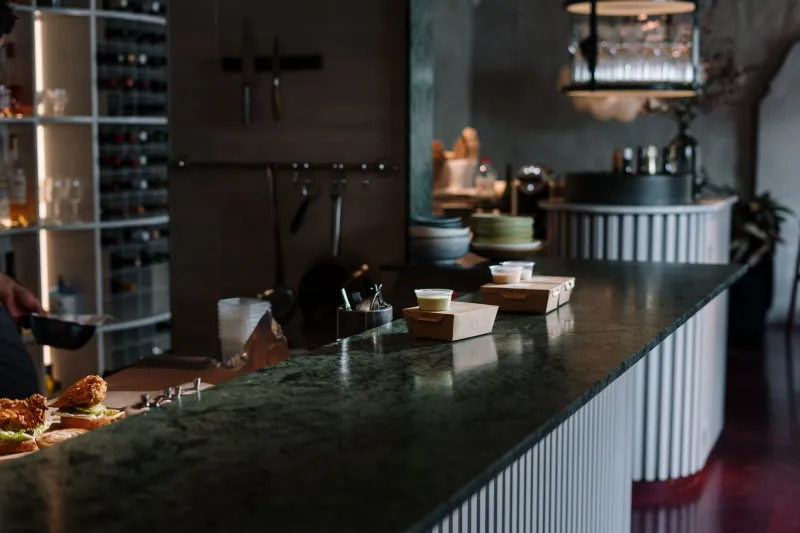
In a traditional bacaro, the food on offer isn't hidden behind laminated pages — it's right there in front of you, usually arranged along the bar in small portions called cicheti. Think of them as Venice's answer to tapas, though any Venetian would wince at that comparison. Tiny rounds of bread topped with salt cod mousse. Crisp little pastry cups filled with something creamy and herb-flecked. Meatballs no bigger than a golf ball, gleaming with a slow-cooked sauce. Slices of cured meat folded over themselves like small, patient letters.
You don't need to know the name of any of it. You just need to look. If it catches your eye, it's probably going to catch your palate too. This is food designed to be seen, smelled, and eaten — not catalogued.
At Il Baccarò, the counter tells its own story. Spend thirty seconds actually looking at what's there before you say a word, and you'll feel considerably less lost. The visual logic of a bacaro spread is surprisingly intuitive once you stop expecting it to behave like a Pret a Manger.
The Pointing System Is Completely Legitimate
Let's be clear: pointing is not rude. It is not the social crime that years of British schooling may have led you to believe. In a bacaro, pointing is practically a dialect. A raised finger directed at a small plate of baccalà mantecato — that whipped salt cod that sounds alarming and tastes transcendent — is a perfectly fluent sentence. The person behind the counter will understand you immediately, probably smile, and get you sorted.
If you want more than one thing, point at several. If you want to know what something is before you commit, point at it with a questioning look — eyebrows up, slight tilt of the head. Nine times out of ten, whoever's serving will either explain in whatever English they have, mime something helpful, or simply hand you a small piece to try. This is not a formal restaurant. Nobody's keeping score.
Wine Works the Same Way
The wine list at a bacaro, when it exists at all, often reads like a personal letter from the owner to people who already know what they're talking about. Grape varieties you've never encountered. Regions that don't appear on the standard map of Italian wine that most of us carry around in our heads. Natural wines with cloudy appearances that look, frankly, a bit wrong if you're used to something crystal-clear from a supermarket shelf.
Again: trust the counter. Or rather, trust the person behind it.
Asking for a recommendation is the most useful thing you can do. Even a simple "something light" or "something a bit fuller" — said in English, gestures entirely optional — will get you somewhere good. At Il Baccarò, the wines are chosen with intention. Nobody's poured something onto the list because it was cheap or convenient. If you tell them what you usually drink and ask for something in that direction, you'll likely end up with something better than what you'd have chosen yourself.
The ombra — a small glass of wine, the traditional bacaro measure — is worth knowing about. It's not a half-pint, not a full glass. It's a modest pour designed to be drunk fairly quickly, paired with a bite or two of cicheti, and then possibly followed by another. The whole system is built around flexibility and movement, not commitment. Order small. Order often. See where it takes you.
Read the Room, Not the Board
Some of the most useful information in a bacaro isn't written anywhere. Watch what other people are eating. Notice which plates are being refilled most often — that's usually a reliable indicator of what's worth having. If someone next to you at the counter gets handed something that makes them close their eyes briefly in satisfaction, that's your cue.
This kind of ambient ordering — picking up on the social energy of a room rather than following a prescribed list — is deeply Italian in spirit, and it's something that comes naturally once you stop trying to control the experience. The bacaro rewards people who pay attention to their surroundings rather than their phones.
The Anxiety Is the Entrance Fee
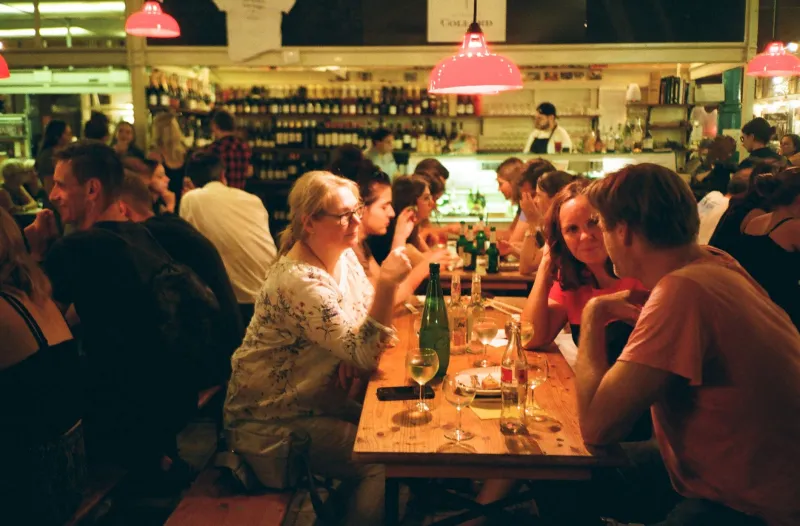
There's a moment, usually about ten minutes into your first proper bacaro visit, when the slight anxiety of not knowing exactly what you're doing transforms into something else entirely. A kind of looseness. A willingness to just be where you are, eating what's in front of you, talking to whoever's nearby, not particularly worried about what comes next.
That shift is what the bacaro has always been for. It's why Venetians have been standing at these counters for centuries, not sitting at tables with laminated menus and a server who checks in every eight minutes. The informality isn't accidental — it's the whole architecture of the thing.
British visitors, in our experience, often take a little longer to reach that looseness than, say, a group of Romans who've wandered in off the street. There's something in the cultural wiring that makes us want to understand the rules before we play. But once you get there — once you've pointed at something without knowing its name, drunk a small glass of something unexpected, and had a brief wordless exchange with the person across the counter that somehow communicated everything it needed to — you'll understand why this way of eating has lasted as long as it has.
You don't need the translation. You never really did.