Why the Loudest Room in Dublin Might Be the Best Place to Have an Honest Conversation
You'd think that a quiet corner, a booth of your own, and a bit of breathing room would be the recipe for a decent conversation. That's what most of us were raised to believe. Keep the background noise down, give people their space, and the words will flow. It's the logic behind every carefully arranged British pub, with its upholstered benches, its separate tables, its polite hush by nine o'clock on a Tuesday.
And yet, somehow, the opposite keeps proving itself true.
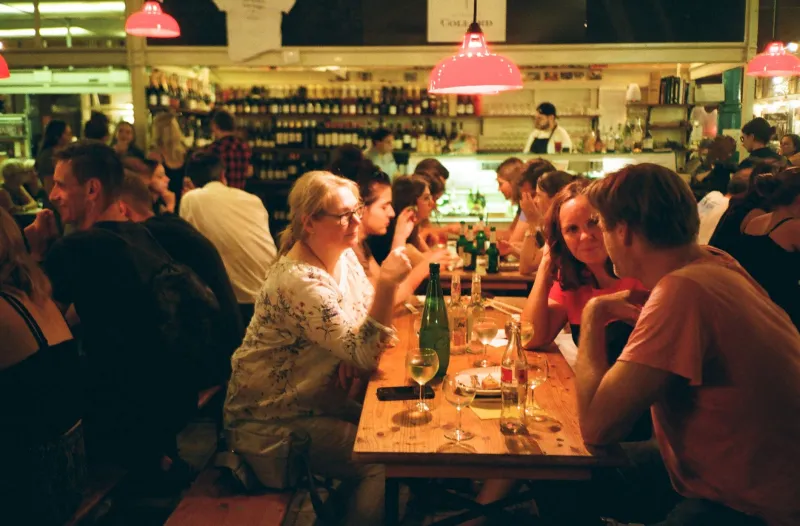
Step into a proper bacaro — the kind of low-ceilinged, shoulder-packed Venetian wine bar that inspired places like Il Baccarò here in Dublin — and within fifteen minutes you'll be mid-conversation with someone you've never met, laughing about something you couldn't have predicted, and wondering why every evening out doesn't feel this alive. The room is loud. Your elbows are touching someone else's. The barman is shouting across the counter. And somehow, none of it gets in the way. If anything, it's the whole point.
The Myth of the Quiet Corner
British pub culture has long prized the idea of personal territory. You find your spot, you claim your table, you build a small fortress of coats and bags and half-finished pints around yourself and your group. It's comfortable. It's familiar. It's also, if we're being honest, a fairly efficient way to avoid talking to anyone you didn't already know when you walked in.
The bacaro works on a completely different philosophy. There are no tables to claim, no corner to retreat to. You stand. You shift. You make room. The physical arrangement isn't just a practical response to a small space — it's a social design choice, even if nobody sat down and consciously designed it. When there's nowhere to hide and no furniture to define your boundaries, the social rules change almost immediately.
Psychologists who study proximity and social bonding have a term for this: propinquity. The simple fact of being physically close to someone — even a stranger — increases the likelihood of connection. Not because closeness is magical, but because it removes the friction. You don't have to decide to approach someone. You're already there. The conversation starts not with effort but with inevitability.
What the Noise Actually Does
Here's the part that really surprises people. The noise — the overlapping voices, the clinking glasses, the general hum of a packed room — doesn't obstruct conversation. It transforms it.
When a room is loud, you lean in. You speak more directly. You drop the performative bits of conversation — the careful throat-clearing, the polished anecdotes, the social posturing that fills quieter spaces — because there simply isn't room for them. You say what you mean, because saying anything at all requires a bit of effort. What comes out tends to be more honest, more immediate, and more interesting.
There's also something about shared sensory experience that bonds people quickly. When everyone in a room is navigating the same friendly chaos — reaching past each other for olives, apologising for a sloshed wine, laughing at the absurdity of the crush — a kind of collective ease sets in. You're all in it together. That shared mild discomfort, paradoxically, is one of the fastest routes to warmth.
Discomfort as a Social Tool
It sounds strange to frame it this way, but the slight physical discomfort of the bacaro — the standing, the squeezing, the lack of a proper seat — is doing serious social work. Comfort, in the wrong doses, makes people passive. Give someone a sofa and a reserved table and they'll settle into their evening like it's a performance to be watched rather than a room to be part of.
The bacaro keeps everyone slightly on their toes. Not anxious — just alert. Present. When you're standing with a glass in hand, you're more likely to turn around, catch someone's eye, shift into a new cluster of people. The movement of the room becomes part of the experience, and movement is social. It creates encounters that a static, seated evening never could.
Dublin has always had a strong pub culture, and nobody here is suggesting that the local is going anywhere. But there's a reason that the city's newer Italian wine bars have built such loyal followings so quickly. People are recognising, often without being able to articulate it, that something different is happening in those rooms. The energy is different. The conversations are different. They go home feeling like they actually talked to people, rather than just sat near them.
The Cicheti Effect
Food plays a role in this too, and it's worth mentioning. The small plates tradition — cicheti in Venice, the kind of bite-sized, shareable things that line the counter at a bacaro — changes how people interact with each other and with their surroundings. You're not anchored to a meal. You're grazing, moving, picking at things, sharing without ceremony. Food becomes part of the social fabric rather than the centrepiece of a fixed ritual.
When you're not sitting down to a structured dinner, the meal becomes an excuse to keep the evening fluid. Another glass, another plate, another conversation. The night doesn't have a predetermined shape, and that openness is infectious. People stay longer, talk more, and leave with that particular kind of satisfied tiredness that comes from genuine human contact rather than just a full stomach.
What Dublin Gets That Venice Always Knew
Venice invented the bacaro centuries ago, partly out of necessity — the city is dense, space is precious, and standing at a counter was simply the most practical way to serve a lot of people quickly. But what began as pragmatism became culture. Venetians didn't just accept the standing and the noise; they built an entire social philosophy around it. The bacaro became the place where class distinctions blurred, where a fisherman and a merchant could lean on the same counter and share the same wine.
Dublin, in its own way, has always understood something similar. The city has never been particularly precious about its social spaces. There's a reason the craic here is legendary — it's not manufactured, it's structural. Put people in close proximity, give them something good to drink, and get out of the way.
At Il Baccarò, that's more or less the operating principle. The room isn't designed to impress you into silence. It's designed to pull you in, shuffle you around, and hand you a glass of something worth talking about. The noise is part of the welcome. The chaos is part of the charm.
And if you end up in conversation with a stranger by the end of the night, that's not an accident. It's the whole idea.