Espresso, Cornetto, and Absolutely Nothing Else: The Italian Morning Ritual That Puts British Breakfast to Shame
There's a particular kind of chaos that defines a British morning. The alarm goes off at seven, the kettle's on by seven-oh-two, and by half past you're already scrolling emails with one hand and buttering toast with the other. Breakfast isn't really a meal — it's a transaction. You fuel up, you get out, you get on with it.
In Italy, that sentence would make very little sense.
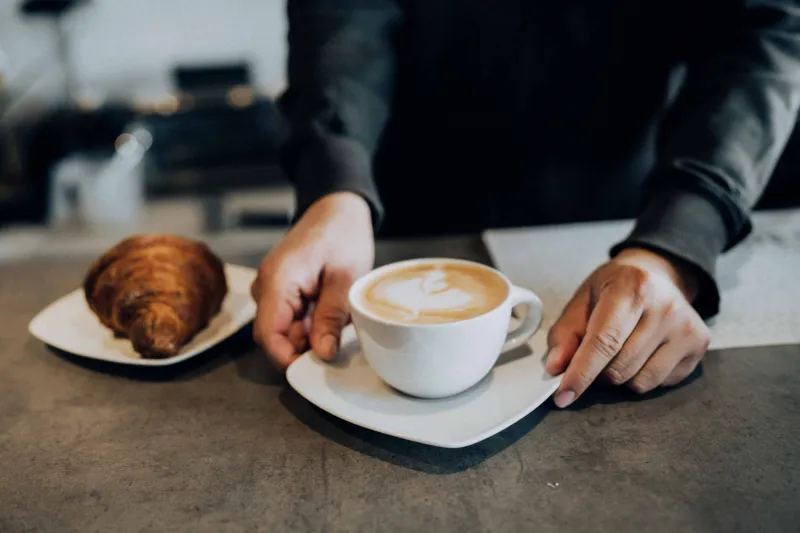
For most Italians, breakfast — la colazione — is not about fuel. It's not about optimising your morning or front-loading your calories for productivity. It's about standing at a bar counter, drinking a single, perfect espresso, eating a cornetto that's just warm enough, and pausing. Actually pausing. For five, maybe ten minutes, before the day begins.
That's it. That's the whole philosophy.
And yet somehow, it changes everything.
The Bar Counter as Morning Sanctuary
Walk into any Italian bar — not a pub, but the kind of neighbourhood café that opens at six in the morning and smells of ground coffee and vanilla pastry — and you'll notice something immediately: nobody is sitting down. Or rather, very few people are. The morning ritual happens standing up, at the counter, elbow to elbow with strangers and neighbours alike.
This isn't a design flaw. It's entirely intentional.
The standing bar creates a kind of enforced brevity. You're not settling in for a working breakfast. You're not setting up a laptop. You order, you drink, you exchange a few words with the barista or the person beside you, and you leave. The whole thing takes less than ten minutes — but those ten minutes belong entirely to you.
Marcello, one of our senior bartenders at Il Baccarò who grew up in Padova, puts it simply: "In Italy, the morning coffee is sacred. Not because of the coffee itself — though it must be good — but because of what it represents. It's the one moment before the world makes demands on you. You protect it."
Protect it. That word is doing a lot of work, and it's worth sitting with.
What Goes in the Cup (and What Doesn't)
Let's talk about the espresso itself, because British coffee culture — despite its recent and genuine improvements — still gets this slightly wrong in ways that matter.
An Italian morning espresso is small, strong, and drunk quickly. It is not a vehicle for milk, flavoured syrups, or oat-based alternatives. It is not consumed from a cup the size of a cereal bowl. It is not something you carry around in a branded paper cup for forty-five minutes while it goes cold.
The cornetto — Italy's answer to the croissant, though softer, slightly sweeter, and altogether more yielding — is eaten in a few bites. It might be plain, filled with apricot jam, or laced with custard cream. It is not a full breakfast. It is not meant to be.
And that, perhaps, is the hardest thing for British sensibilities to accept: the Italian breakfast is deliberately, unapologetically insufficient by the standards of a full English. It is not trying to be a meal. It is trying to be a moment.
Why British Mornings Feel Like a Sprint Before the Race Has Started
There's a reason so many UK professionals arrive at their desks already exhausted. The morning, rather than serving as a gentle transition into the day, has become a compressed rehearsal of everything that's wrong with how we work. We check our phones before we've fully woken up. We eat standing at the kitchen counter, or worse, in the car. We treat the commute as dead time to be filled rather than breathing room to be used.
Italian breakfast culture doesn't solve any of this structurally. But it offers a counter-argument in the form of a ritual — a small, repeatable act of deliberateness that says: before I give this day to everyone else, I give five minutes to myself.
Silvia, who manages front-of-house at Il Baccarò and moved to Dublin from Bologna eight years ago, laughs when asked about adapting to Irish mornings. "The first thing I noticed was that people here apologise for eating breakfast. Like it's self-indulgent. In Italy, skipping it would be the strange thing. You don't skip the beginning of your day."
That reframing — breakfast as the beginning rather than an optional preamble — is quietly radical.
Bringing the Ritual Home (Without Moving to Naples)
You don't need to relocate to adopt this. You don't even need an Italian coffee machine, though a decent moka pot on the hob will take you most of the way there for about a tenner.
What you do need is a small act of resistance against the tyranny of the productive morning.
Here's what that could look like in practice:
Make the coffee properly. Not instant. Not a pod machine left to run while you're in the shower. Take the three minutes it requires. The ritual of making it is part of the point.
Eat something light and deliberate. A good pastry, a piece of good bread with proper butter, something that requires no assembly and no thought. The Italian cornetto is ideal — increasingly available at continental delis across the UK — but the principle matters more than the specific food.
Put the phone down. Or at least, don't start with it. Give yourself the first five minutes before the inbox opens. This is harder than it sounds and more valuable than almost anything else on this list.
Stand up, if you can. This sounds odd, but there's something about eating at a counter rather than slumping at a table that keeps the ritual clean and brief. You're pausing, not stalling.
What the Italians Know That the Rest of Us Are Still Learning
The deeper insight buried in Italian breakfast culture isn't really about coffee or pastries at all. It's about the relationship between how you begin something and how you experience everything that follows.
A morning that starts with intentional stillness — even five minutes of it — tends to produce a different quality of attention for the rest of the day. Not because of the caffeine, but because of the practice of choosing, just briefly, not to be rushed.
At Il Baccarò, we see this play out every day. The customers who pull up a stool at the bar, order a proper coffee, and take their time — they leave differently than they arrived. Looser, somehow. More present.
That's not magic. It's just what happens when you treat the start of your day as something worth doing well.
British mornings are getting better — the food culture has shifted enormously in the last decade, and good coffee is no longer hard to find. But the philosophy still lags behind. We're still optimising the morning rather than inhabiting it.
Maybe the answer has been sitting in a small cup at a bar counter in Padova, Bologna, or just off Dame Street in Dublin all along.