Why British Expats Are Ditching the Pub and Finding Their People at an Italian Wine Bar
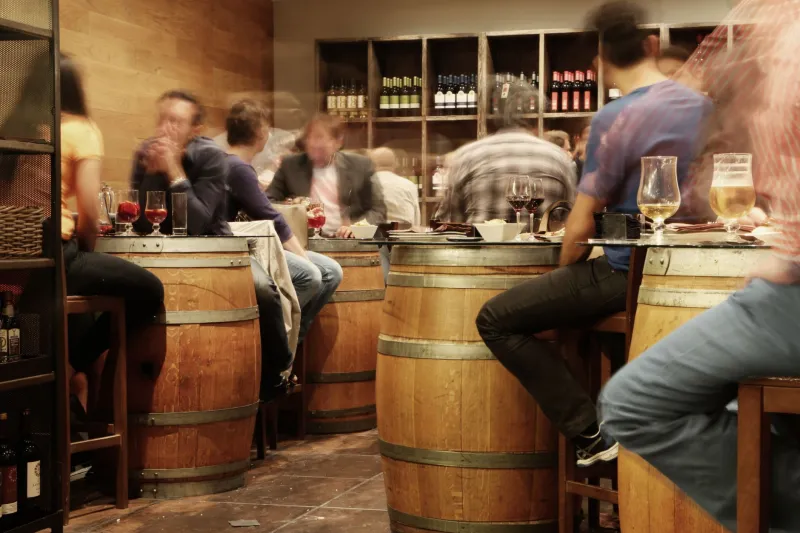
There's a moment that several British expats in Dublin describe in almost identical terms. It's somewhere around the second glass of wine, standing at a counter that's slightly too narrow for comfort, talking to someone they've never met before. The conversation has moved, within the space of twenty minutes, from what they do for work to something they actually care about. Nobody planned it. Nobody had a name badge. And somehow, that's exactly why it worked.
For a certain kind of British professional — the kind who's moved to Dublin for a fintech role or a media job, who misses the ease of home without quite wanting to admit it — the city's Italian wine bar scene has become an unlikely sanctuary. Not because it's trying to be. But because it isn't trying to be anything at all.
The Problem With Networking (And Why the Pub Doesn't Fix It)
British expats arriving in Dublin often discover the same thing: the pub, for all its warmth and mythology, doesn't always deliver on the promise of community. Rounds structure the evening in ways that can feel obligatory. Noise levels and the cultural expectation of not interrupting a group already mid-conversation create invisible barriers. Networking events, meanwhile, are their own particular form of social purgatory — lanyards, elevator pitches, and the quiet desperation of people scanning the room for someone more useful.
Sarah, a 34-year-old communications consultant who moved from Bristol to Dublin three years ago, puts it plainly. "I went to every expat event going for the first six months. LinkedIn meetups, industry drinks, the lot. And I'd come home feeling more alone than when I left the flat. The conversations never went anywhere real."
What changed things for her, she says, was stumbling into a bacaro-style wine bar on a Tuesday evening with no particular intention. "I ordered something I didn't recognise, asked the person behind the bar what it was, and ended up in a forty-minute conversation about the Veneto with a stranger who turned out to be a chef. That was the first time I'd felt properly at ease since moving."
What the Bacaro Model Actually Does to a Room
The Venetian bacaro tradition isn't complicated in concept, but it's surprisingly difficult to replicate without understanding its underlying logic. The bar counter is central — not as a place to wait for a table, but as the destination itself. Standing is intentional. The small plates arrive without ceremony. The wine is poured generously and without theatre.
What this creates, almost accidentally, is a social environment with no fixed hierarchy. You can't retreat to a private table. You're physically close to people you don't know. The informality signals, at a level below conscious thought, that nobody here is performing.
Dr James Holt, a social psychologist based in London who has studied belonging and community formation in urban environments, suggests this isn't accidental. "Environments that reduce social signalling — the absence of reserved seating, menus you have to study, dress codes, even the requirement to sit — lower the psychological cost of initiating conversation. You're not interrupting someone's evening. You're both just there, in the same space, with the same glass."
For British expats specifically, this matters in a particular way. British social culture, for all its warmth, is built on a scaffolding of context. You need a reason to speak to someone. A shared commute, a mutual friend, a work introduction. The bacaro removes that requirement entirely. The shared space is the reason.
A Different Kind of Regular
Mark, a 41-year-old software architect who relocated from Manchester, describes becoming a regular at Il Baccarò as something that crept up on him. "I started going because the wine list was interesting and I could eat without committing to a full sit-down meal. And then I kept going because I knew I'd see people I liked. It took me about three weeks to realise I'd actually made friends. Not contacts. Friends."
This distinction — friends versus contacts — comes up repeatedly in conversations with British expats who've found community through Dublin's Italian hospitality scene. The bacaro doesn't ask anything of you professionally. It doesn't require you to have an opinion about the city's housing market or to perform enthusiasm about your job. It asks only that you're present, and perhaps curious about what's in your glass.
The food helps too. Small plates — cicheti, bruschette, whatever the kitchen has decided is worth making that day — are designed to be shared, or at least discussed. Offering someone a taste of something, or asking what they're eating, is one of the oldest and most natural conversation openers in existence. It works because it's genuine. You really do want to know what that is.
Something the Pub Never Quite Managed
None of this is to suggest that Dublin's pub culture lacks merit — it manifestly doesn't. But there's a specific gap that the bacaro fills, particularly for newcomers who haven't yet built the kind of long-term friendships that make the pub feel like home rather than just a room with beer in it.
The Italian hospitality tradition carries within it a particular philosophy: that the guest's comfort is the host's first obligation, and that comfort is best achieved not through formality but through its deliberate absence. You are welcome here. You don't need to earn it.
For British expats navigating a city that is familiar enough to be disorienting — same language, different rhythms, different social codes — that kind of uncomplicated welcome turns out to be exactly what's needed. Not a networking event. Not a themed expat meetup. Just a counter, a glass, and enough space to let a conversation find its own direction.
Sarah, the communications consultant, is still friends with the chef she met on that Tuesday evening. They've since introduced each other to a dozen other people. "It all came from one glass of wine I didn't recognise," she says. "That feels very Italian to me. Nothing planned. Everything somehow perfect."