Italian Wine Under €30: How to Order Like You Know What You're Doing (Even When You Don't)

Let's establish something immediately: nobody is born knowing what Vermentino tastes like. Nobody emerges from childhood with an instinctive grasp of the difference between a Nero d'Avola and a Montepulciano d'Abruzzo. Wine knowledge is accumulated slowly, through drinking, through asking questions, and through the occasional misfires that turn out to be excellent stories later.
The problem is that Italian wine, in particular, has developed a reputation for being impenetrably complicated. Twenty-plus regions, hundreds of indigenous grape varieties, a labelling system that sometimes names the grape and sometimes names the place and sometimes names neither — it's enough to make anyone reach for the Prosecco and call it an evening.
But here's the thing about Italian wine under €30: it's where the most interesting drinking is happening right now. Not the prestige bottles, not the Barolos that require a mortgage and a decade of patience. The everyday wines, the regional bottles, the stuff that Italian families drink on a Tuesday without making a ceremony of it. That's the territory worth exploring. And it's considerably less intimidating than it appears.
Forget Regions. Start With Mood.
The single most useful thing you can do when approaching an Italian wine list is to stop thinking in terms of geography and start thinking in terms of what you actually want from the next hour.
Want something bright, slightly sharp, and good with anything fried or salty? You want a white from the north. Soave, if it's a decent producer rather than the industrial stuff, is a revelation — clean, mineral, with a faint almond note on the finish that makes it one of the best matches for cicheti going. Verdicchio from the Marche is another one: it's got more body than you'd expect and a lovely savoury quality that makes it interesting to drink on its own.
Want a red that doesn't demand your full attention but rewards it if you give it? Montepulciano d'Abruzzo. Not to be confused with Vino Nobile di Montepulciano, which is a different wine entirely from Tuscany — a confusion that has caused untold grief at wine bars across Europe. Montepulciano d'Abruzzo is the grape, grown in the Abruzzo region, and at its best it's soft, slightly rustic, and deeply satisfying with anything involving cured meat or aged cheese.
The Ones Worth Ordering Confidently
A few bottles that punch reliably above their price point and will make you look like you've thought about this:
Falanghina — A white from Campania, ancient in origin and currently enjoying a well-deserved revival. It's aromatic without being perfumed, has good acidity, and pairs beautifully with seafood. If you see it on a list, it's almost always worth ordering. The name is also enjoyable to say, which shouldn't matter but slightly does.
Cerasuolo d'Abruzzo — This is the rosé made from Montepulciano grapes, and it's nothing like the pale, cautious Provençal rosés that have dominated British wine lists for the past decade. It's deep in colour, full in flavour, and serious enough to drink through a whole meal rather than just an aperitivo. If someone at the table insists on rosé and you want to introduce them to something better, this is your move.
Nerello Mascalese from Sicily — Specifically from the slopes of Etna, where volcanic soil produces reds with a particular mineral tension that's unlike anything else in Italy. They tend to be lighter in colour than you'd expect from a Sicilian red, with high acidity and a savoury, almost smoky quality. They're also, increasingly, very good value before the wine press catches up with the region and prices rise accordingly.
Ribolla Gialla from Friuli — A white that's been made in the far northeast of Italy for centuries and is now experiencing something of a moment among natural wine enthusiasts, though you don't need to care about that to enjoy it. Crisp, textured, slightly nutty, and excellent with anything involving fresh cheese.
The Ones to Approach With Mild Caution
Chianti is not a bad wine. But "Chianti" on a wine list, without further specification, is a broad enough category to cover everything from genuinely excellent small-producer Sangiovese to something that tastes like it was bottled on a deadline. If you're going to order Chianti, look for Chianti Classico — the historic heartland — and ideally a producer name you can Google later.
Prosecco deserves more respect than it gets from wine enthusiasts, but it also deserves more scrutiny than it gets from casual drinkers. The difference between a good Prosecco Superiore from Valdobbiadene and the industrial versions that fill supermarket shelves is significant. If you're at a bacaro that takes its wine list seriously, ask which Prosecco they're pouring and why. You'll either get an interesting answer or a slightly uncomfortable pause that tells you something useful.
How to Actually Order
The most effective strategy at a wine bar, particularly one with an engaged and knowledgeable team, is also the simplest: describe what you want rather than naming what you think you should want.
"Something dry and white that goes with cured meats" is a better starting point than "a Pinot Grigio please." "A red that's not too heavy, I'm not having a main" is more useful information than "do you have Merlot?"
Good wine bar staff — and the best Italian establishments in Dublin have very good wine bar staff — are not waiting for an opportunity to make you feel foolish. They're waiting for an opportunity to put something excellent in your hand. Give them the information they need and let them do their job.
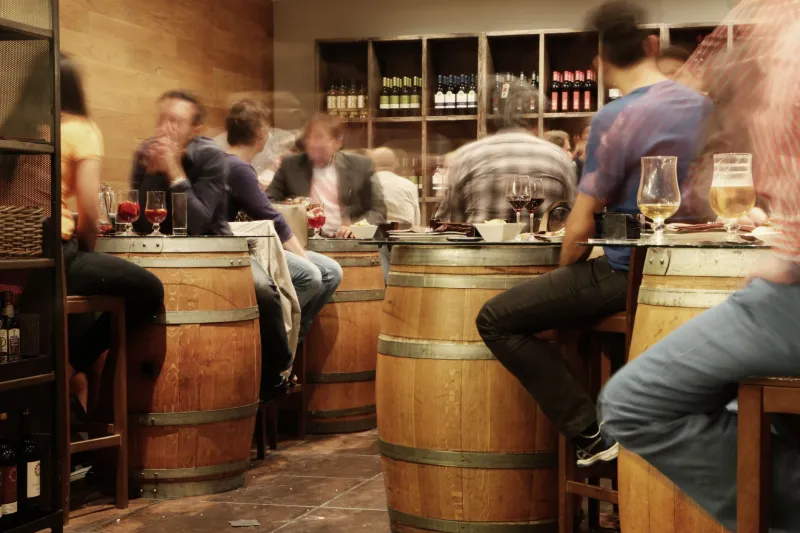
The other thing worth knowing: at a bacaro, it's entirely acceptable to order a single glass of something unfamiliar, decide it's not quite right for you, and ask for something different. This isn't a failure. This is tasting. It's what the format is designed for.
One Last Thing
The under-€30 Italian wine market is not a consolation prize. It's not what you drink when you can't afford the good stuff. It's where generations of Italian families have been finding their Tuesday-evening pleasure for centuries, and it's where some of the most honest, most characterful, most genuinely enjoyable bottles in Europe currently sit.
You don't need to memorise regions or master a vocabulary. You need to stay curious, ask questions without embarrassment, and be willing to try something you haven't heard of. The worst that happens is you discover it's not for you. The best that happens is you find a wine you'll be ordering for the rest of your life.
Either way, it's a better evening than defaulting to the Prosecco.