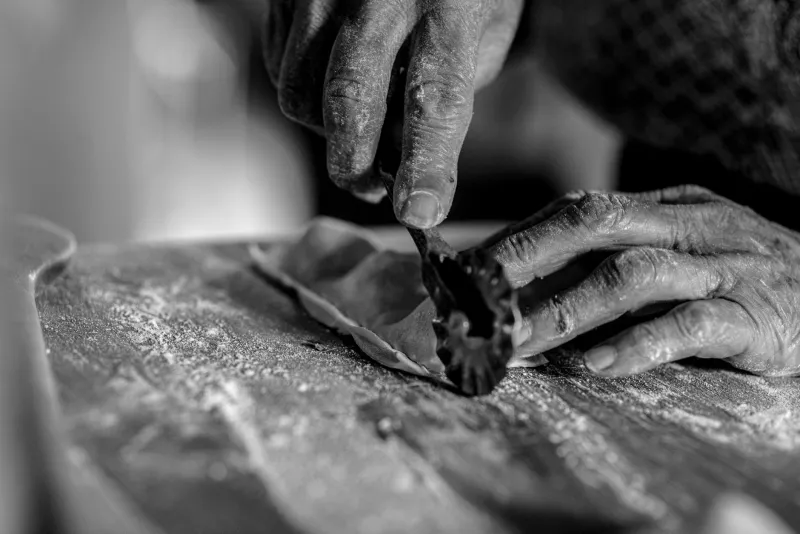
The Recipes That Never Leave the House: What Italian Chefs Keep Sacred in Dublin

There's a particular kind of silence that falls over an Italian chef when you ask about their grandmother's cooking. It's not an awkward silence. It's more like the pause before someone decides how much of themselves they're willing to share with a stranger.
We've been asking that question a lot lately — quietly, over espresso, after service — to the Italian chefs and food folk who've made Dublin their home. What we found wasn't a list of secret ingredients or hidden techniques. It was something closer to a philosophy: the idea that some food simply doesn't belong in a restaurant at all.
The Dish That Stays Home
For many Italian cooks, the most important recipe they own is also the one least likely to ever appear on a menu. Sometimes it's a regional dish so specific that the ingredients don't travel well. Sometimes it's a preparation so labour-intensive that serving it commercially would be financially absurd. And sometimes — perhaps most often — it's a dish that carries so much emotional weight that putting a price on it feels wrong.
One Venetian-born chef we spoke to described his mother's bigoli in salsa — a thick whole-wheat pasta with a sauce of slow-cooked onions and salted anchovies — as "the most honest food I've ever eaten." He's cooked it perhaps three hundred times in his life. He has never once put it on a menu. "It would be like framing a love letter and hanging it in a gallery," he said. "It's not made for that."
That sentiment comes up again and again. Italian culinary culture draws a firm line between cucina di casa — home cooking — and cucina del ristorante. The restaurant kitchen is a stage. The home kitchen is something else entirely.
What Makes a Recipe Sacred
It would be easy to romanticise this, to reduce it to nostalgia and sentiment. But there's something more practical going on too.
Many of these hidden recipes are technically unforgiving in ways that make restaurant replication genuinely difficult. A slow-braised ragù that takes eight hours and constant attention. A hand-rolled pasta that requires a specific touch developed over decades. A regional bread that relies on a sourdough starter older than most of the people in the kitchen.
Then there's the question of ingredients. Several Dublin-based Italian cooks told us about dishes that depend on things simply unavailable here — a specific variety of dried chestnut from a particular valley in Liguria, say, or a cured pork fat from a single producer in Emilia-Romagna who sells only to locals. You can approximate. You can substitute. But the dish that comes out the other side isn't really the same dish, and these cooks know it.
For others, the barrier is more cultural than culinary. Certain preparations belong to specific times of year, specific occasions, specific tables. A Sicilian cook described her family's Christmas buccellato — a dense fig-and-nut pastry — as something that would lose all meaning served outside of December, outside of family, outside of the particular noise and chaos of her mother's kitchen. "If I put it on a menu in September," she laughed, "my mother would never speak to me again."
Should Restaurants Break the Rules?
Here's where it gets interesting. There's a growing conversation in food circles — and we've been part of it here at Il Baccarò — about whether the wall between home cooking and restaurant cooking should occasionally come down.
Not permanently, and not without care. But there's something genuinely compelling about the idea of a special tasting evening built around exactly these kinds of hidden recipes. Not as a gimmick, not as a marketing exercise, but as an honest act of sharing — a chef cooking something deeply personal for a small group of people who understand what they're being offered.
Some restaurants across Italy have experimented with this, particularly in regions with strong agritourismo traditions, where the line between hosting and cooking was always blurred. Guests book not just a meal but an experience — a window into a kitchen that operates by different rules.
The appeal for diners is obvious. People are increasingly hungry for authenticity in a way that goes beyond buzzwords. They want to understand where a dish comes from, what it means, who made it and why. A recipe that a chef has never served before, cooked once for a room of twelve people on a Tuesday evening, carries a charge that no standard menu item can match.
What Gets Lost, What Gets Gained
The counterargument is worth taking seriously. Part of what makes these recipes precious is precisely their privacy. Once something is shared widely, it changes. It becomes a product. The emotional texture that makes nonna's version different from any other version is inseparable from the context in which it was made and eaten.
And yet — Italian culinary culture has always been about transmission. Recipes survive because they're passed on. They die when they're hoarded. Every dish that now feels classical and timeless was once someone's private secret, shared eventually and absorbed into a broader tradition.
Maybe the question isn't whether to share these recipes, but how. With care. With context. With the story attached, not stripped away in the name of efficiency or scalability.
A Meal You Have to Earn
At Il Baccarò, we think about this often. Our kitchen is built on Italian culinary tradition, but tradition is a living thing — it grows through conversation, not just repetition. The recipes that never make it to our menu are the ones we hold closest, and perhaps, occasionally, the ones we'd most like to share.
If you're curious about what that might look like — an evening where the menu doesn't exist yet, where the dish being cooked has never been served commercially before — it's worth asking. Some things are worth coming to the table for.